By: Kasarachi Onwuliri
Just 50 years ago, men dominated college campuses. Today, the script has flipped. Women outpace men in college enrollment, persistence, and graduation rates. In a study published by the Postsecondary National Policy Institute in 2020, women made up nearly 59% of all college students in the US. Meanwhile, enrollment among men has been steadily declining, a gender gap wider than ever before.
In recent weeks, there has been discourse on social media about the increasing decline of men in higher education. From X to TikTok, many shared their opinion on this matter. Women and men who achieved four-year degrees were quick to dive head-first into this topic.
The conversation was lacking something. The perspective lacking was men who did not attend higher education institutions.
“I felt like the conversation was disingenuous,” said Josh Louis, 29, Expressing feelings about social media’s tendency to beat down on people.
The conversation sparks the question, What are some factors behind this decline?
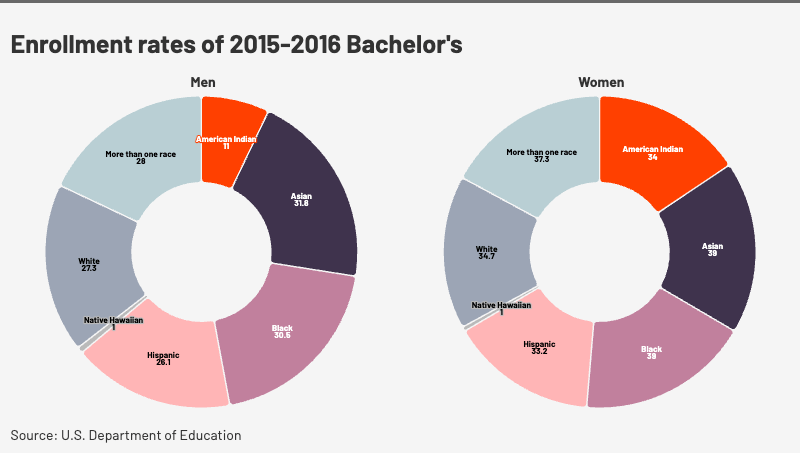
The Pew Research study Fewer young men are in college. Especially at 4-year schools explores the declining rate of men entering college in the past decade. Since 2011, the rate of men enrolling in 4-year institutions went from 47% to 42% in 2022.
When examining the breakdown by racial group of individuals 18-24 enrolled in college, White men dropped 40% from a previous 49%, Black men from 42% to 37%, and Hispanic men 42% to 33%.
The study also stated that this decline was simply because men don’t want to go to school.
“I had the opportunity to go to college, I tried a semester. It wasn’t for me,” said Jeremiah Rivera, 29.
For many men, this disinterest in school started in high school.
“I remember getting burnt out my junior year,” said Josh
According to an article published by Brookings in 2021, 89% of women graduated high school vs 83% of boys.
Among racial groups, women graduate at higher rates than their counterparts.
92% of White women compared to 87% of men, 87% Hispanic women compared to 78% men, Black women 85% compared to 76% men and 96% Asian women compared to 93% men.
While these are genuine concerns that men have to deal with, women who joined the conversation said ‘What about us?’
Women are feeling frustrated and confused about men higher education. Many vocalized they, too, had similar situations, often growing up in the same environment’s as men, yet they tend to pivot and take the direction of higher education.
Sarah Atsu, 22, explains her frustration with her brother older brother regarding his life choices.
“High school was a very interesting time for my brother that’s when things started to fall apart. He was always a smart student but he had a lot of frustrations…I got kicked out of school around the same time…It was an amalgamation of different things cultural and traditional values that ultimately didn’t work out in his favor.”
She further discusses factors that led them down different paths.
Sarah’s feelings go beyond just personal struggle, it reveals the growing tension many young men face today. Her brother’s frustrations, in high school, shaped by both cultural pressures and rigid expectations, mirror a broader crisis.
Social media has been discussing men’s roles in society for some time now. While social norms have left men being the main financial provider for their families, decades of social change is challenging this expectation.
As these traditional expectations persist, the question becomes: how can men fulfill the role of provider without a college degree?
“When I came out of high school, I was making $9 an hour. I thought I was making money because it was more than $7.25,” said Josh.
The University of Massachusetts study How College Impacts Salary and Future Earning Potential, breaks down weekly earnings of individuals with varying degree levels. High school grads with no college made on average $905, individuals with an associate degree made $1,012, those with a bachelor’s $1,499, and individuals with advanced degrees made $1,864.
Although traditional schools unlock high earning potentials, men still opt for the nontraditional route and still seeing success.
From college classrooms to job sites: what are men doing instead?
A recent CNBC video explored a shift in Gen Z from classrooms to workshops. The video highlights how young workers are redefining success by entering trades that offer stability, growth and hands-on experience, without the burden of student loans.
One of those young men is Jeremiah Rivera. In 2018, just a few years after high school, he launched his own landscaping business.
(listener discretion advised)
Jeremiah represents a growing number of Gen Z men choosing trades over traditional classrooms. As four-year college enrollment drops, blue collar industries, such as construction, electrical work, to landscaping are starting to see a renewed interest.
The Nasdaq published an article discussing 10 Highest-Paying Blue Collar Jobs for 2025. Jobs from wind turbine technicians to elevator technicians range from $61,770 to $102,420 annually.
Josh is another young man who is benefiting from the blue-collar life.
He found his stride in the construction industry after bouncing between jobs in his early twenties. He landed a position a a family friends construction company. Today, he is earning steady income.
“I didn’t go to college, but I’m still learning just on a different track,” he said. “Getting a certification will open more doors for me, and I can still grow without the debt.”

The narrative that men who don’t attend college are lost or unmotivated doesn’t show the whole picture. As Josh and Jeremiah’s stories show, success doesn’t always come with a diploma. Sometimes, it comes with grit, skills, and a different vision.
As society continues redefining success, men’s voices outside the classroom deserve more than just judgment. They deserve to be heard, understood, and included in the conversation.
 Site Title
Leave a comment